
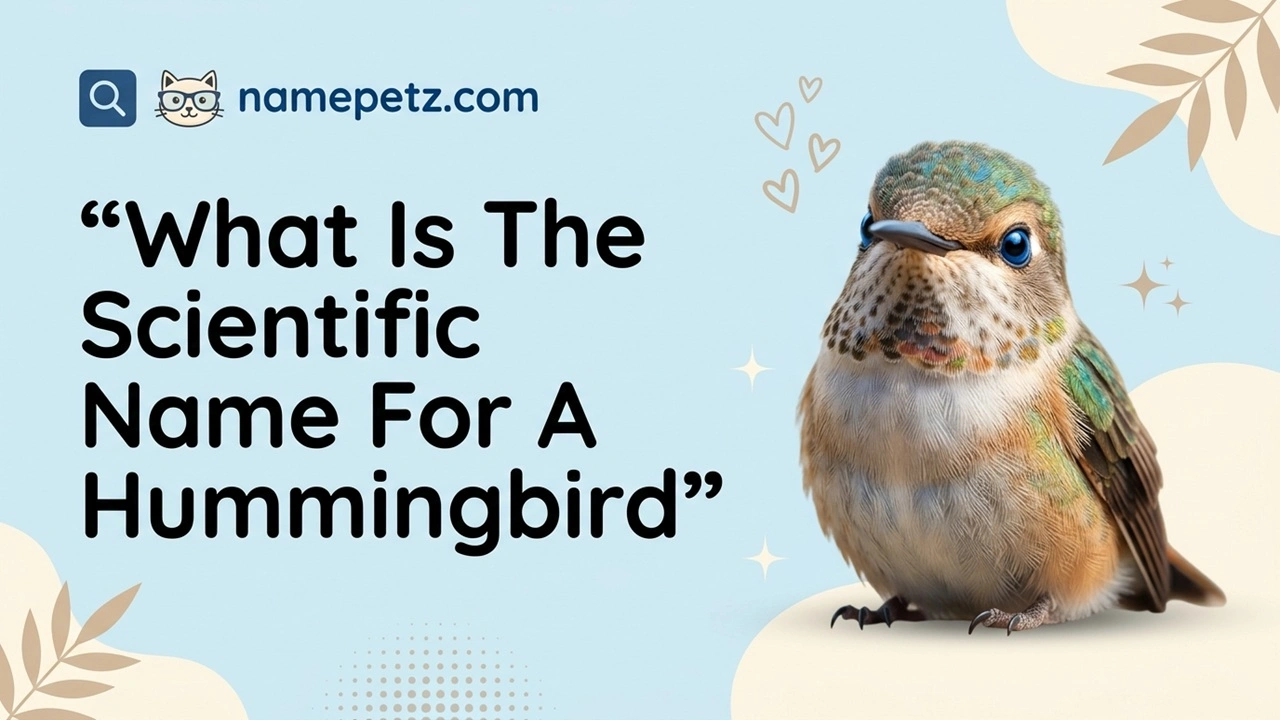
Many people ask, what is the scientific name for a hummingbird when they want to learn more about these tiny and colorful birds. Hummingbirds are famous for their fast wings and ability to hover in the air. They live in many parts of the Americas and visit flowers to drink sweet nectar. Learning their scientific name helps us understand how scientists classify and study these amazing birds around the world.
If you wonder, what is the scientific name for a hummingbird, the answer is connected to a group of birds known as Trochilidae. Scientists use scientific names to identify animals correctly. These names help people avoid confusion because common names can be different in various places. Scientific names create a clear system that people everywhere can understand and use.
[name_generator type=”Humminbird”]
This guide will explain what is the scientific name for a hummingbird in a simple and easy way. You will learn about hummingbird classification, interesting facts, and why scientific names are important. Understanding these details can help students, bird lovers, and curious readers learn more about hummingbirds. It is a fun way to explore nature and discover how scientists organize the living world around us every day.
Fun Facts About Hummingbirds
Hummingbirds are among the smallest birds in the world. They can flap their wings very quickly and even fly backward. Because of these amazing abilities, many people search for what is the scientific name for a hummingbird and want to learn more about these fascinating birds.
These colorful birds drink nectar from flowers and help plants by spreading pollen. Moreover, hummingbirds have excellent memory and can remember where they found food before. Therefore, they play an important role in nature.
Learning fun facts helps us understand why hummingbirds are so special. In addition, studying what is the scientific name for a hummingbird teaches us how scientists identify and classify different bird species.
| Hummingbird Name | Meaning | Origin |
| Bee Hummingbird | Smallest Hummingbird | Cuba |
| Ruby-Throated Hummingbird | Red Throat Feathers | North America |
| Anna’s Hummingbird | Named After Anna Masséna | California |
| Broad-Tailed Hummingbird | Wide Tail Feathers | North America |
| Black-Chinned Hummingbird | Black Chin Marking | North America |
| Costa’s Hummingbird | Named After Louis Costa | Southwest USA |
| Rufous Hummingbird | Reddish-Brown Color | North America |
| Allen’s Hummingbird | Named After Charles Allen | California |
| Violet-Crowned Hummingbird | Purple Crown | Mexico |
| Green Violetear | Green Plumage | Central America |
| Magnificent Hummingbird | Beautiful Appearance | Americas |
| White-Eared Hummingbird | White Ear Patch | Mexico |
| Buff-Bellied Hummingbird | Buff Colored Belly | Texas |
| Blue-Throated Hummingbird | Blue Throat | Mexico |
| Sword-Billed Hummingbird | Long Beak | South America |
What Is the Scientific Name for a Hummingbird?
Many people ask what is the scientific name for a hummingbird when learning about birds. The scientific name for the hummingbird family is Trochilidae. Scientists use this name to classify all hummingbird species together.
Scientific names help researchers communicate clearly around the world. While common names may change from place to place, the scientific name remains the same. As a result, scientists can avoid confusion.
Understanding what is the scientific name for a hummingbird also helps students learn about animal classification. It provides a universal way to identify these amazing birds.
| Scientific Name | Meaning | Origin |
| Trochilidae | Hummingbird Family | Greek |
| Trochilus | Small Bird | Greek |
| Mellisuga helenae | Bee Hummingbird | Latin |
| Archilochus colubris | Ruby-Throated Hummingbird | Greek |
| Calypte anna | Anna’s Hummingbird | Greek |
| Selasphorus platycercus | Broad-Tailed Hummingbird | Greek |
| Archilochus alexandri | Black-Chinned Hummingbird | Greek |
| Calypte costae | Costa’s Hummingbird | Greek |
| Selasphorus rufus | Rufous Hummingbird | Latin |
| Selasphorus sasin | Allen’s Hummingbird | Greek |
| Amazilia violiceps | Violet-Crowned Hummingbird | Latin |
| Colibri thalassinus | Green Violetear | Greek |
| Eugenes fulgens | Magnificent Hummingbird | Greek |
| Basilinna leucotis | White-Eared Hummingbird | Greek |
| Amazilia yucatanensis | Buff-Bellied Hummingbird | Latin |
Hummingbird Scientific Classification
The scientific classification of hummingbirds helps scientists organize living things. When discussing what is the scientific name for a hummingbird, classification provides a complete picture of where hummingbirds belong in nature.
Hummingbirds belong to the kingdom Animalia because they are animals. They also belong to the class Aves, which includes all birds. Furthermore, they belong to the family Trochilidae.
Classification makes studying animals easier. Therefore, scientists can compare hummingbirds with other bird species and understand their relationships better.
| Classification Level | Meaning | Origin |
| Animalia | Animal Kingdom | Latin |
| Chordata | Has Backbone | Greek |
| Aves | Birds | Latin |
| Apodiformes | Swift-Like Birds | Greek |
| Trochilidae | Hummingbird Family | Greek |
| Trochilus | Small Bird | Greek |
| Vertebrata | Backboned Animals | Latin |
| Eukaryota | Complex Cells | Greek |
| Metazoa | Multicellular Animals | Greek |
| Bilateria | Symmetrical Animals | Latin |
| Neornithes | Modern Birds | Greek |
| Ornithurae | Bird-Tailed Group | Greek |
| Tetrapoda | Four-Limbed Animals | Greek |
| Amniota | Egg-Laying Vertebrates | Greek |
| Chordates | Notochord Animals | Greek |
The Family Name of Hummingbirds
The family name for hummingbirds is Trochilidae. This family includes more than 360 known hummingbird species. Therefore, when people ask what is the scientific name for a hummingbird, they often learn about this important family name.
Scientists group birds into families based on shared features. Hummingbirds share similar body structures, feeding habits, and flying abilities. As a result, they belong to the same family.
The family Trochilidae is unique because its members can hover in place and fly backward. These special skills make hummingbirds different from most other birds.
| Family Member | Meaning | Origin |
| Bee Hummingbird | Tiny Species | Cuba |
| Ruby-Throated Hummingbird | Red Throat | North America |
| Anna’s Hummingbird | Named Species | California |
| Rufous Hummingbird | Red Color | North America |
| Costa’s Hummingbird | Named Species | Southwest USA |
| Allen’s Hummingbird | Named Species | California |
| Broad-Billed Hummingbird | Wide Beak | Mexico |
| White-Eared Hummingbird | White Marking | Mexico |
| Green Violetear | Green Color | Central America |
| Violet-Crowned Hummingbird | Purple Crown | Mexico |
| Blue-Throated Hummingbird | Blue Throat | Mexico |
| Magnificent Hummingbird | Beautiful Bird | Americas |
| Buff-Bellied Hummingbird | Buff Belly | Texas |
| Rivoli’s Hummingbird | Named Species | Mexico |
| Sword-Billed Hummingbird | Long Beak | South America |
Meaning of the Scientific Name Trochilidae
The word Trochilidae comes from Greek language roots. It is the official scientific family name for hummingbirds. Therefore, understanding this word helps answer what is the scientific name for a hummingbird.
Scientists use Greek and Latin words because they create a standard naming system. Consequently, people around the world can study the same animals without confusion.
The scientific name Trochilidae represents all hummingbird species. It serves as an important part of bird classification and scientific research.
| Scientific Term | Meaning | Origin |
| Trochilidae | Hummingbird Family | Greek |
| Trochilus | Small Bird | Greek |
| Ornithology | Study of Birds | Greek |
| Aves | Birds | Latin |
| Apodiformes | Swift-Like Birds | Greek |
| Species | Type of Animal | Latin |
| Genus | Group of Species | Latin |
| Family | Related Groups | Latin |
| Order | Classification Level | Latin |
| Class | Scientific Category | Latin |
| Kingdom | Largest Group | Latin |
| Taxonomy | Classification Science | Greek |
| Biology | Study of Life | Greek |
| Zoology | Study of Animals | Greek |
| Vertebrate | Animal with Backbone | Latin |
Types of Hummingbirds and Their Scientific Names
There are hundreds of hummingbird species around the world. Each species has its own scientific name. Therefore, learning these names expands our understanding of what is the scientific name for a hummingbird.
Different species live in different habitats. Some prefer forests, while others live in deserts or mountains. Moreover, each species has unique colors and features.
Scientific names help researchers identify species accurately. As a result, conservation efforts become more effective and organized.
| Common Name | Scientific Name | Origin |
| Bee Hummingbird | Mellisuga helenae | Cuba |
| Ruby-Throated Hummingbird | Archilochus colubris | North America |
| Anna’s Hummingbird | Calypte anna | California |
| Rufous Hummingbird | Selasphorus rufus | North America |
| Costa’s Hummingbird | Calypte costae | Southwest USA |
| Allen’s Hummingbird | Selasphorus sasin | California |
| Green Violetear | Colibri thalassinus | Central America |
| Violet-Crowned Hummingbird | Amazilia violiceps | Mexico |
| Broad-Tailed Hummingbird | Selasphorus platycercus | North America |
| White-Eared Hummingbird | Basilinna leucotis | Mexico |
| Buff-Bellied Hummingbird | Amazilia yucatanensis | Texas |
| Blue-Throated Hummingbird | Lampornis clemenciae | Mexico |
| Rivoli’s Hummingbird | Eugenes fulgens | Mexico |
| Broad-Billed Hummingbird | Cynanthus latirostris | Mexico |
| Sword-Billed Hummingbird | Ensifera ensifera | South America |
Most Common Hummingbird Species
Several hummingbird species are commonly seen across the Americas. When studying what is the scientific name for a hummingbird, learning about common species provides helpful examples.
The Ruby-Throated Hummingbird is one of the most recognized species in North America. Similarly, Anna’s Hummingbird is popular along the western coast. These birds often visit gardens and feeders.
Understanding common species helps bird watchers identify hummingbirds more easily. Furthermore, it increases appreciation for these beautiful birds and their role in nature.
| Species Name | Meaning | Origin |
| Ruby-Throated Hummingbird | Red Throat | North America |
| Anna’s Hummingbird | Named Species | California |
| Rufous Hummingbird | Red Color | North America |
| Costa’s Hummingbird | Named Species | Southwest USA |
| Allen’s Hummingbird | Named Species | California |
| Black-Chinned Hummingbird | Black Chin | North America |
| Broad-Tailed Hummingbird | Wide Tail | North America |
| Broad-Billed Hummingbird | Wide Beak | Mexico |
| Green Violetear | Green Plumage | Central America |
| Violet-Crowned Hummingbird | Purple Crown | Mexico |
| White-Eared Hummingbird | White Ear Mark | Mexico |
| Buff-Bellied Hummingbird | Buff Belly | Texas |
| Blue-Throated Hummingbird | Blue Throat | Mexico |
| Bee Hummingbird | Tiny Species | Cuba |
| Rivoli’s Hummingbird | Named Species | Mexico |
Ruby-Throated Hummingbird Scientific Name
The Ruby-Throated Hummingbird is one of the most famous hummingbird species in North America. Its scientific name is Archilochus colubris. Many people learn this species first when studying what is the scientific name for a hummingbird because it is common and easy to recognize.
This hummingbird gets its name from the bright red feathers on the male’s throat. Moreover, it visits flowers and feeders throughout the spring and summer months. Therefore, bird watchers often enjoy seeing this colorful species.
Understanding scientific names helps people identify birds correctly. As a result, Archilochus colubris remains an important example when learning hummingbird classification.
| Common Name | Scientific Name | Meaning | Origin |
| Ruby-Throated Hummingbird | Archilochus colubris | Red-Throated Bird | North America |
| Male Ruby-Throated | Archilochus colubris | Bright Red Throat | North America |
| Female Ruby-Throated | Archilochus colubris | Female Species | North America |
| Juvenile Ruby-Throated | Archilochus colubris | Young Bird | North America |
| Eastern Hummingbird | Archilochus colubris | Eastern Region | USA |
| Garden Visitor | Archilochus colubris | Visits Gardens | North America |
| Nectar Feeder | Archilochus colubris | Drinks Nectar | Americas |
| Pollinator Bird | Archilochus colubris | Helps Flowers | Americas |
| Tiny Flyer | Archilochus colubris | Small Bird | Americas |
| Fast Winged Bird | Archilochus colubris | Rapid Wings | Americas |
| Flower Visitor | Archilochus colubris | Visits Flowers | Americas |
| Migratory Bird | Archilochus colubris | Seasonal Traveler | Americas |
| Colorful Hummingbird | Archilochus colubris | Bright Colors | Americas |
| Forest Hummingbird | Archilochus colubris | Woodland Bird | Americas |
| Common Hummingbird | Archilochus colubris | Popular Species | Americas |
Anna’s Hummingbird Scientific Name
Anna’s Hummingbird has the scientific name Calypte anna. This beautiful species is common along the western coast of North America. Therefore, it often appears in discussions about what is the scientific name for a hummingbird.
Anna’s Hummingbird stands out because of its bright pink and red head feathers. In addition, it can survive in cities, gardens, and natural habitats. As a result, many people see this bird regularly.
Learning the name Calypte anna helps bird enthusiasts identify this species accurately. Furthermore, scientific names make communication easier among researchers worldwide.
| Common Name | Scientific Name | Meaning | Origin |
| Anna’s Hummingbird | Calypte anna | Named After Anna | California |
| Male Anna’s | Calypte anna | Colorful Male | USA |
| Female Anna’s | Calypte anna | Female Bird | USA |
| Garden Hummingbird | Calypte anna | Garden Visitor | USA |
| Coastal Hummingbird | Calypte anna | Coastal Bird | West Coast |
| Urban Hummingbird | Calypte anna | City Bird | USA |
| Pink-Throated Bird | Calypte anna | Pink Feathers | USA |
| Nectar Feeder | Calypte anna | Drinks Nectar | Americas |
| Pollinator Bird | Calypte anna | Pollinates Flowers | Americas |
| Tiny Flyer | Calypte anna | Small Bird | Americas |
| Fast Flyer | Calypte anna | Quick Flight | Americas |
| Flower Visitor | Calypte anna | Flower Feeder | Americas |
| Bright Hummingbird | Calypte anna | Colorful Bird | Americas |
| Common Western Species | Calypte anna | Western Bird | North America |
| Year-Round Resident | Calypte anna | Permanent Resident | USA |
Broad-Tailed Hummingbird Scientific Name
The scientific name of the Broad-Tailed Hummingbird is Selasphorus platycercus. This species lives mainly in western North America. Consequently, it is an important example when exploring what is the scientific name for a hummingbird.
The bird gets its common name from its wide tail feathers. Moreover, males produce a distinctive sound during flight. Therefore, bird watchers can often recognize them by both sight and sound.
Scientific names such as Selasphorus platycercus allow researchers to distinguish this species from other hummingbirds. As a result, classification becomes more accurate.
| Common Name | Scientific Name | Meaning | Origin |
| Broad-Tailed Hummingbird | Selasphorus platycercus | Wide-Tailed Bird | North America |
| Male Broad-Tailed | Selasphorus platycercus | Adult Male | USA |
| Female Broad-Tailed | Selasphorus platycercus | Adult Female | USA |
| Mountain Hummingbird | Selasphorus platycercus | Mountain Bird | Rockies |
| Forest Visitor | Selasphorus platycercus | Forest Species | USA |
| Flower Pollinator | Selasphorus platycercus | Pollinator | Americas |
| Nectar Feeder | Selasphorus platycercus | Drinks Nectar | Americas |
| Fast Flyer | Selasphorus platycercus | Quick Wings | Americas |
| Tiny Bird | Selasphorus platycercus | Small Species | Americas |
| Summer Visitor | Selasphorus platycercus | Seasonal Bird | USA |
| Colorful Flyer | Selasphorus platycercus | Bright Plumage | Americas |
| Territorial Bird | Selasphorus platycercus | Protects Area | Americas |
| High-Altitude Bird | Selasphorus platycercus | Mountain Habitat | USA |
| Garden Visitor | Selasphorus platycercus | Visits Gardens | Americas |
| Common Western Bird | Selasphorus platycercus | Western Species | North America |
Black-Chinned Hummingbird Scientific Name
The scientific name for the Black-Chinned Hummingbird is Archilochus alexandri. This species is widely found in western and southern parts of North America. Therefore, it is another key species when studying what is the scientific name for a hummingbird.
The male has a dark throat that shines purple in sunlight. Additionally, this bird adapts well to different environments, including deserts and gardens. As a result, it thrives in many habitats.
Knowing the name Archilochus alexandri helps bird watchers and researchers identify this species correctly. Furthermore, scientific names create consistency across different countries and languages.
| Common Name | Scientific Name | Meaning | Origin |
| Black-Chinned Hummingbird | Archilochus alexandri | Black-Chinned Bird | North America |
| Male Black-Chinned | Archilochus alexandri | Adult Male | USA |
| Female Black-Chinned | Archilochus alexandri | Adult Female | USA |
| Desert Hummingbird | Archilochus alexandri | Desert Bird | Southwest USA |
| Garden Visitor | Archilochus alexandri | Visits Gardens | Americas |
| Nectar Feeder | Archilochus alexandri | Drinks Nectar | Americas |
| Pollinator Bird | Archilochus alexandri | Flower Pollinator | Americas |
| Tiny Flyer | Archilochus alexandri | Small Bird | Americas |
| Fast Flyer | Archilochus alexandri | Quick Wings | Americas |
| Territorial Bird | Archilochus alexandri | Protects Area | Americas |
| Forest Visitor | Archilochus alexandri | Woodland Bird | Americas |
| Summer Resident | Archilochus alexandri | Seasonal Species | USA |
| Colorful Hummingbird | Archilochus alexandri | Bright Plumage | Americas |
| Common Species | Archilochus alexandri | Frequently Seen | Americas |
| Western Hummingbird | Archilochus alexandri | Western Region | North America |
Where Hummingbirds Live
When learning what is the scientific name for a hummingbird, it is also useful to understand where hummingbirds live. These birds live only in the Americas, from Alaska to the southern tip of South America.
Different hummingbird species prefer different habitats. Some live in tropical rainforests, while others thrive in mountains, deserts, grasslands, and gardens. Therefore, hummingbirds adapt well to many environments.
Moreover, many species migrate long distances to find food and suitable weather. As a result, they can be found in a wide variety of locations throughout the year.
| Habitat Name | Meaning | Origin |
| Rainforest | Tropical Forest | South America |
| Cloud Forest | High Mountain Forest | Andes |
| Desert | Dry Region | North America |
| Grassland | Open Fields | Americas |
| Woodland | Forest Area | Americas |
| Garden | Human-Planted Area | Worldwide |
| Meadow | Flowering Field | Americas |
| Mountain Forest | High Elevation Forest | Americas |
| Shrubland | Bushy Habitat | Americas |
| Coastal Area | Near Ocean | Americas |
| Valley | Lowland Area | Americas |
| Wetland | Water-Rich Habitat | Americas |
| Tropical Forest | Warm Forest | Central America |
| Highland | Elevated Region | Americas |
| Urban Garden | City Habitat | Americas |
Characteristics of Hummingbirds
Hummingbirds have many unique features that make them special. Their tiny size, colorful feathers, and fast wing movements help distinguish them from other birds. Therefore, these traits are important when studying what is the scientific name for a hummingbird.
One of their most impressive abilities is hovering in the air. In addition, they can fly backward, sideways, and even upside down for short moments. As a result, they are among the most skilled flyers in the animal kingdom.
Hummingbirds also have long beaks and tongues that help them reach nectar deep inside flowers. Consequently, they play a major role in pollination.
| Characteristic | Meaning | Origin |
| Hovering Flight | Stay in Air | Hummingbirds |
| Fast Wings | Rapid Wing Beats | Hummingbirds |
| Long Beak | Nectar Feeding Tool | Hummingbirds |
| Tiny Size | Small Body | Hummingbirds |
| Bright Colors | Colorful Feathers | Hummingbirds |
| Excellent Memory | Strong Recall | Hummingbirds |
| Backward Flight | Reverse Flying | Hummingbirds |
| Sharp Vision | Excellent Eyesight | Hummingbirds |
| High Metabolism | Fast Energy Use | Hummingbirds |
| Long Tongue | Nectar Collection | Hummingbirds |
| Pollination | Flower Support | Hummingbirds |
| Migration | Seasonal Travel | Hummingbirds |
| Agility | Quick Movement | Hummingbirds |
| Speed | Fast Flight | Hummingbirds |
| Adaptability | Habitat Flexibility | Hummingbirds |
Why Scientific Names Are Important
Scientific names help people identify animals accurately. When discussing what is the scientific name for a hummingbird, these names provide a universal system used by scientists everywhere.
Common names often vary between countries and languages. However, scientific names remain the same worldwide. Therefore, researchers can communicate clearly without misunderstandings.
Additionally, scientific names show relationships between species. As a result, scientists can study evolution, behavior, and conservation more effectively.
| Scientific Term | Meaning | Origin |
| Trochilidae | Hummingbird Family | Greek |
| Taxonomy | Classification Science | Greek |
| Species | Basic Classification Unit | Latin |
| Genus | Related Species Group | Latin |
| Family | Related Genera | Latin |
| Order | Scientific Category | Latin |
| Class | Major Group | Latin |
| Kingdom | Largest Group | Latin |
| Biology | Study of Life | Greek |
| Zoology | Study of Animals | Greek |
| Classification | Organizing Living Things | Latin |
| Identification | Recognizing Species | Latin |
| Evolution | Change Over Time | Latin |
| Conservation | Protection of Species | Latin |
| Research | Scientific Study | French |
How Scientists Classify Hummingbirds
Scientists classify hummingbirds using a system called taxonomy. This system organizes living things into groups based on shared characteristics. Therefore, it helps answer what is the scientific name for a hummingbird in a structured way.
Researchers study physical features, behavior, genetics, and evolutionary history. Moreover, they compare different species to understand their relationships. As a result, classification becomes more accurate over time.
Taxonomy allows scientists to place hummingbirds within the family Trochilidae and distinguish hundreds of individual species. Consequently, this system helps researchers around the world work together more effectively.
| Classification Group | Meaning | Origin |
| Kingdom Animalia | Animals | Latin |
| Phylum Chordata | Animals with Backbone | Greek |
| Class Aves | Birds | Latin |
| Order Apodiformes | Swift-Like Birds | Greek |
| Family Trochilidae | Hummingbird Family | Greek |
| Genus Archilochus | Bird Group | Greek |
| Genus Calypte | Bird Group | Greek |
| Genus Selasphorus | Bird Group | Greek |
| Species colubris | Ruby-Throated Species | Latin |
| Species anna | Anna’s Species | Latin |
| Species alexandri | Black-Chinned Species | Latin |
| Species platycercus | Broad-Tailed Species | Greek |
| Taxonomy | Classification Science | Greek |
| Evolution | Species Development | Latin |
| Biodiversity | Variety of Life | Greek |
Conclusion
Understanding what is the scientific name for a hummingbird helps us learn more about these amazing birds and their place in nature. While many people know hummingbirds for their bright colors and fast wings, their scientific classification reveals even more fascinating details. The family name Trochilidae connects hundreds of hummingbird species and helps scientists study them accurately around the world.
Learning about hummingbird taxonomy, species names, habitats, and unique characteristics can make bird watching and nature study more enjoyable. Moreover, scientific names create a universal language that helps researchers, students, and bird lovers communicate clearly. Whether you are learning about the Ruby-Throated Hummingbird, Anna’s Hummingbird, or another species, scientific names provide valuable information about each bird.
As you continue exploring what is the scientific name for a hummingbird, you will discover how science helps us understand and protect wildlife. Hummingbirds are small, yet they play an important role in pollination and healthy ecosystems. By learning more about these remarkable birds, we can appreciate their beauty and support efforts to conserve them for future generations.
FAQs
What is the scientific name for a hummingbird?
The scientific name for the hummingbird family is Trochilidae. This name includes all hummingbird species found across the Americas. Scientists use this family name to classify hummingbirds and distinguish them from other bird groups. It provides a standard way to identify these birds and study their behavior, habitats, and evolution.
Why do hummingbirds have scientific names?
Scientific names help scientists identify species correctly. Common names can differ from one country to another, but scientific names stay the same worldwide. This system makes communication easier among researchers and bird enthusiasts. It also helps organize animals into groups based on shared characteristics and evolutionary relationships.
What does Trochilidae mean?
Trochilidae is the scientific family name for hummingbirds. The word comes from Greek roots used in biological classification. Scientists use it to describe the entire hummingbird family. This name includes hundreds of species and helps researchers understand how hummingbirds are related to one another within the bird kingdom.
Are all hummingbirds part of the Trochilidae family?
Yes, all known hummingbird species belong to the Trochilidae family. Although species may differ in size, color, and habitat, they share important characteristics. These similarities include hovering flight, nectar feeding, and fast wing movements. Therefore, scientists place them together within the same family classification.
What is the scientific name of the Ruby-Throated Hummingbird?
The scientific name of the Ruby-Throated Hummingbird is Archilochus colubris. This species is one of the most common hummingbirds in North America. Bird watchers often recognize it by the male’s bright red throat feathers. Its scientific name helps researchers identify it accurately and distinguish it from other hummingbirds.
What is the scientific name of Anna’s Hummingbird?
Anna’s Hummingbird has the scientific name Calypte anna. This species lives mainly along the western coast of North America. It is famous for its colorful pink and red head feathers. Scientific names like Calypte anna help scientists classify species and communicate clearly about specific birds.
How many hummingbird species exist?
Scientists currently recognize more than three hundred sixty hummingbird species. These species belong to the family Trochilidae and live throughout the Americas. New research occasionally updates classifications as scientists learn more about genetics and evolution. Each species has its own scientific name and unique characteristics.
Where do hummingbirds live?
Hummingbirds live only in the Americas, ranging from Alaska to southern South America. Different species prefer different habitats, including rainforests, mountains, deserts, and gardens. Many hummingbirds migrate seasonally to find food and suitable weather. Their adaptability allows them to thrive in a variety of environments.
Why are scientific names important in bird studies?
Scientific names create a universal system for identifying birds. They help researchers avoid confusion caused by different common names. In addition, scientific names show relationships between species and support studies of evolution, behavior, and conservation. This standardized system improves communication among scientists around the world.
How do scientists classify hummingbirds?
Scientists classify hummingbirds using taxonomy, which organizes living things into groups. They study physical features, behavior, genetics, and evolutionary history. Hummingbirds belong to the family Trochilidae within the order Apodiformes. This classification system helps researchers understand how species are related and how they evolved over time.